MINUS

Jamidar's

MINUS

The Original Callbreak

Play India's beloved village card game — MINUS, the original Callbreak.

The trick-taking game played across North Indian card tables, with the rule that makes it bite: taking the most tricks is not the point. You score by making your bid — take at least as many tricks as you said you would. Fall short, even by one, and the whole bid goes negative. Take more and there's no penalty, but no bonus either.

Unlike ordinary Callbreak, spades isn't always trump — win the auction and you name the cut suit yourself.

4 players 13 tricks Live voice Hindi · Hinglish · English No betting · No real money
The MINUS table mid-hand: four players around a sage-green
                  table, cards played into the middle, your own hand fanned
                  along the bottom.

A hand, start to finish

Five decisions and thirteen tricks

Every screen below is the actual game, caught mid-hand. Nothing here is a mock-up.

  1. The MINUS home screen with Resume, New Game and
                      Multiplayer.
    01

    Sit down

    Three bots that bid like people, or a room full of friends. The game keeps your seat either way — walk out mid-hand and it is still there when you come back.

  2. The auction: five cards in hand and a bid wheel offering a
                      number or NAHI BOLNA to pass.
    02

    The auction

    Five cards each — that is all you get to judge by. Bid for the right to name the kaat, the cut suit that will beat everything else for the rest of the hand, or say nahi bolna and let somebody else carry the risk.

  3. The final bid in a live room: thirteen cards fanned along
                      the bottom, every player's number on the board, and an
                      estimate of how many tricks this hand can take.
    03

    Name your number

    The rest of the deck comes out and everybody commits: how many of the thirteen tricks will you take? Nobody may pass. Hold real strength and you can take over the kaat with a big enough bid — and the table gets one chance to fight you for it.

  4. Mid-trick: cards played into the centre of the table, each
                      seat showing its bid and score.
    04

    Thirteen tricks

    Follow suit if you can. If you can beat what is on the table, you must — no quietly ducking out of a trick you did not want. Every seat carries its bid where you can see it, so you always know who is desperate.

  5. The round scoreboard: what each player bid, what they took,
                      and the points added or taken away.
    05

    Make your bid, or minus

    Make your bid — or more — and you score exactly what you bid; extra tricks earn nothing, so there's no reward for greed. Come up short and the whole bid comes off your total instead. First past the target takes the game; everyone else has usually been negative at least once on the way.

Play online

Your table, wherever everyone happens to be

Rooms in one tap

Open a room and share the code, a link or a QR. Friends drop in from wherever they are — or hit Random Live Players and take the next free seat going.

Nobody gets stranded

Lose signal, take a call, lock your phone: a bot covers your seat so the table keeps playing, and hands it straight back the moment you return. Even the host can walk out — the game elects a new one and carries on.

Told when it matters

A friend calling you to a table, somebody walking into your room, a hand waiting on your card — the phone tells you, and each kind can be switched off on its own.

Talk across the table

Live voice chat and one-tap taunts, because half of this game has always been what gets said while the cards are down.

A live four-player room at the end of a round: two real
                    players and two bots, each with what they bid, what they
                    took, and the points it cost them.
A real room, mid-match
The running scores in the same room: a column per player,
                    round by round, with the totals underneath.
Every round, every player
The online menu: resume, friends, random live players, create
                    room and join room.
Everything online, one screen

The rules, short

Two rounds of bidding, then thirteen tricks

  1. The auction. Five cards each. Players bid for the right to name the kaat — the cut suit that beats everything else for the rest of the hand.
  2. The cut. Whoever takes the auction names the kaat, and the rest of the deck is dealt out.
  3. The second bid. Now everyone commits to a number: how many of the thirteen tricks they will take. Nobody may pass. A player holding real strength can take over the cut with a big enough bid — and the table gets one chance to fight back.
  4. The play. Follow suit if you can. If you can beat the card on the table, you must. Thirteen tricks, no mercy.
  5. The scoring. Make your bid or more and you score it. Fall short and you score it minus — going over never hurts, but never helps. That is the whole game, and the whole cruelty.
Meet-your-bid scoring Kaat takeover & war Bot difficulty: easy · medium · hard Target 31 · 41 · 51

The table

You know these four

THE MINUS SHOWDOWN

Aaj kaun bolega sabse badi kaat?

म्हारी काट पक्की सै!

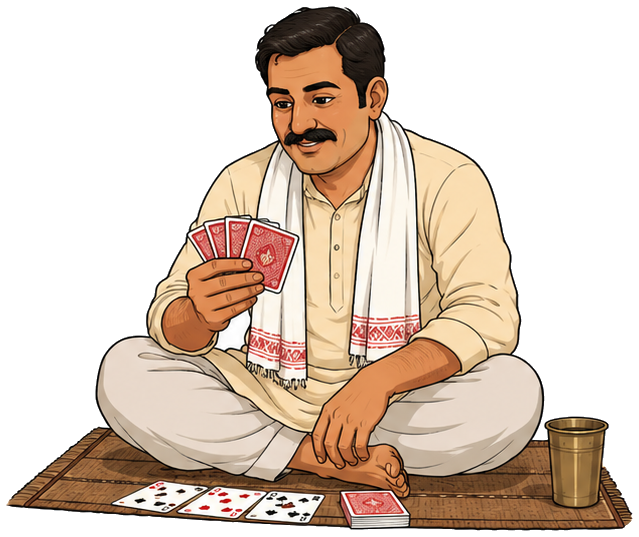
Hardeep, holding his cards.
HARDEEP

आज तो तू गया, भईया!

Ram Swarup, holding his cards.
RAM SWARUP

माइनस थारै नाम!

Phool Singh, holding his cards.
PHOOL SINGH

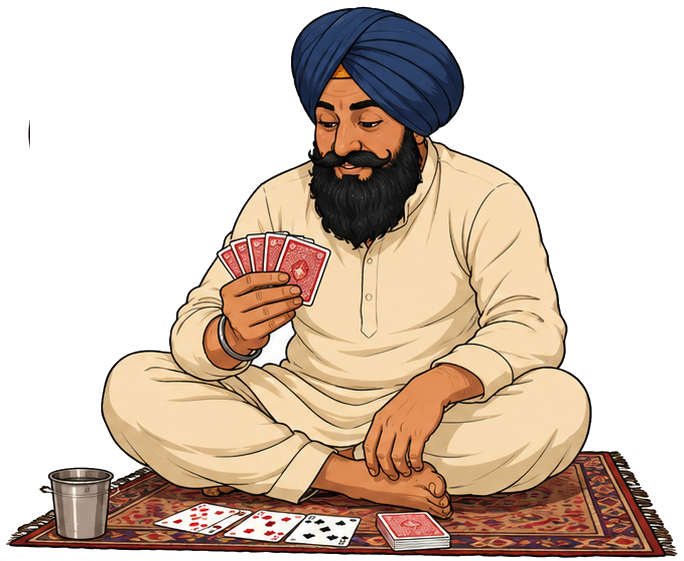
ਆ ਜਾ, ਹਰਾ ਕੇ ਵਿਖਾਵਾਂ!

Gurbax, holding his cards.
GURBAX

Pick whichever one you want to be — they are four players at a card table, not four places. Every seat plays by the same rules.

Get the game

Free to play. No ads in the middle of a hand.

On the App Store for iPhone and iPad, on Google Play for Android, or open it in a browser and start playing. Play solo against three bots that actually bid like people, or open a room and call your own table together.

The browser version is the whole game — same table, same bots, same rooms — and needs no install at all.

Made in India

Made in India, with love — by Indians, for India

MINUS is designed, built and maintained in India — the rules, the art direction, the online play and the app itself. Suggestions and bug reports go straight to us, and they get read.